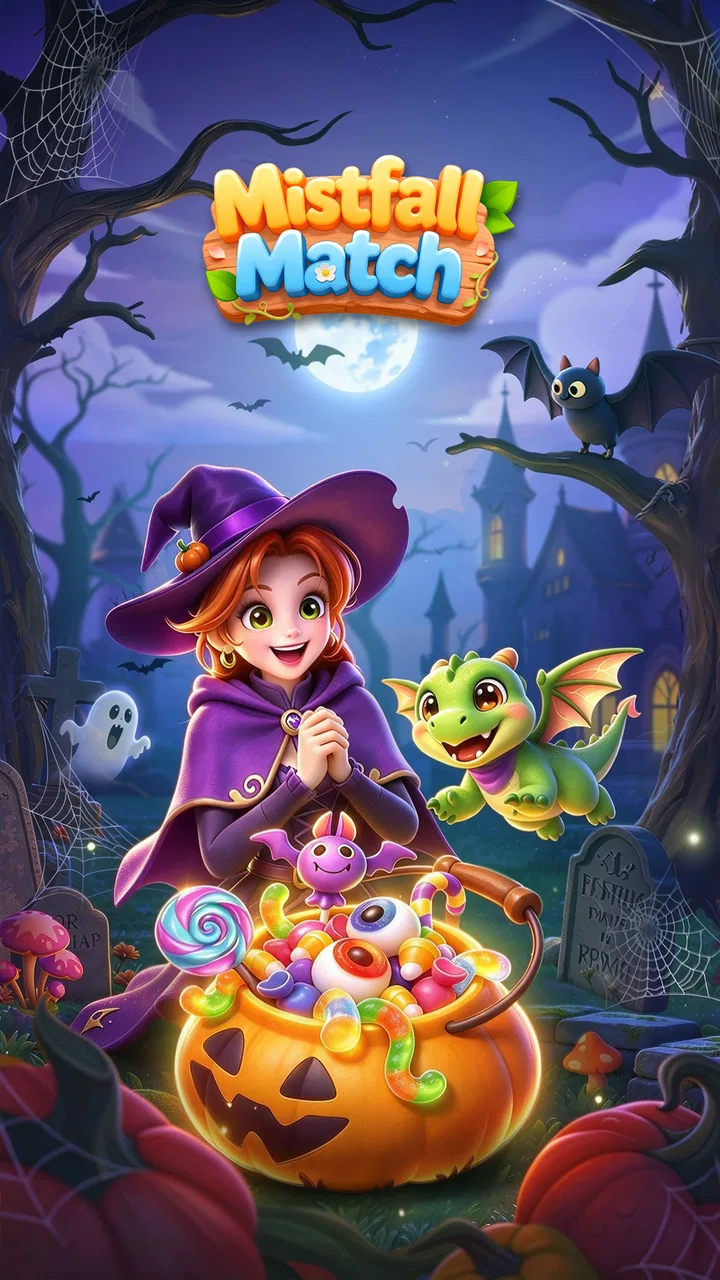
Mistfall Match: Design & Blast
- 4.9
- Rating
- 1.00M
- Installs
- Free
- Price

 Analysis by App-foxy
I picked up Mistfall Match: Design & Blast expecting a light match-three distraction, but its garden-building theme gives the familiar puzzle loop a more settled purpose. Instead of treating each board as an isolated challenge, the game frames progress around creating a personal garden oasis. That small change matters: matching pieces becomes a way to move a place forward, not merely a way to clear another level.
It is a free casual game from Flyyes, Inc., rated for Everyone 10+, and it fits the kind of short session I can play while waiting for dinner or taking a break from work. The store summary focuses on merging, matching, and building, and that is a fair description of the experience. I would not call it a deep strategy game, but I found enough decision-making in the boards and enough visual progress in the garden to make repeated sessions feel more purposeful than a completely disposable puzzle.
How it works when a shared device is part of the routine
The most natural household use case is a shared phone or tablet passed between people at different moments. One person can play a few boards in the morning, another can pick it up later, and the garden gives everyone an immediately visible sense of what has been done. That makes it easier to understand the appeal for a household looking for a calm, turn-based pastime rather than a game that demands everyone be online together.
You May Also Like

 Blood Strike: 2.5 Anniversary
Blood Strike’s Loadouts Turn Every Drop Into a Tactical Gamble
A close look at Blood Strike’s custom loadouts: how fast access to signature weapons reshapes its battle royale rhythm, rewards preparation, and narrows the gap between fights.

 Pandora - Music & Podcasts
Pandora’s Music Is Easy to Start, but Harder to Recover
Pandora’s strength is its low-effort path from a seed to a station. Its weak spot is how much confidence it asks you to place in connection, setup, and quiet recovery.

 8 Ball Pool
 Is Built on Rivalries, Rematches, and Routine
A close look at the rivalries, rematches, shared routines, and unanswered safety questions that turn a quick pool match into a persistent mobile community.

 Samsung Music
’s Quiet Strength Is Playing What You Already Own
Its reach comes less from spectacle than from dependable access to a personal library. That simplicity is both the app’s strongest retention engine and its ceiling.

 AccuWeather: Weather Radar
AccuWeather Review: A Quick, Clear Forecast for Everyday Decisions
For everyday plans, the best forecast is the one you can understand quickly. AccuWeather makes rain timing, radar, and local conditions easy to act on, with a few trade-offs.

 Hill Climb Racing
Why Hill Climb Racing Still Turns Crashes Into One More Run
A tiny car, a bumpy hill and one more upgrade: Hill Climb Racing keeps resurfacing because its simple chaos makes every near-miss feel personal.
More From Our News Desk



I especially liked the fact that the basic appeal is easy to explain. A new player does not need a long tutorial from me: match pieces, work toward the board objective, and use the resulting progress to develop the garden. The design-and-blast combination gives the game two rhythms. The puzzle is the active part, while the garden is the slower reward that encourages another attempt.
That structure also creates the first important trade-off. If you enjoy match-three games mainly for fast board clearing, the garden layer may feel like an interruption between puzzles. If you prefer seeing a setting gradually become more attractive, it gives otherwise familiar mechanics a reason to continue. I landed in the middle. I enjoyed the garden as a destination, but I would not choose this game over a purer puzzle title when I want uninterrupted board action.
For a shared device, I would establish a simple household rule before anyone starts: decide whether the game is a communal project or belongs to one player. That is not a feature claim about the app; it is practical advice based on how progress-based games work. If several people make choices in the same garden, they should agree on the style they want. Otherwise, one person may spend the available progress on a design direction another person dislikes.
What I would check before handing over the device
The game is free to download, but it includes in-app purchases ranging from $0.99 to $99.99 per item. That range is the detail I would take most seriously in a household setting. A child can see a purchase prompt without understanding the difference between a small optional item and a much larger transaction, so I would not leave payment decisions to chance. The safest approach is to keep purchases under the device owner’s control and make it clear who is allowed to approve them.
I would also avoid treating the shared garden as if it were a separate profile for every person. The game may be perfectly enjoyable as one household project, but a shared device does not automatically mean separate progress, preferences, or boundaries. If individual ownership matters, I would use separate device accounts or separate devices where available instead of assuming the game will divide progress for us.
This is one of the less obvious practical points with a game like this: the garden is not just decoration. It becomes a record of decisions. A child may see it as a creative space, while an adult may see it as a progression track. Agreeing on that expectation prevents a surprisingly common source of friction—someone changing an area that another player considered “theirs.”
On Android, the minimum operating system is Android 7.0, which makes the compatibility requirement relatively approachable for older supported devices. I would still check the device’s available storage, battery condition, and store account before installing, especially if this is going onto an older shared tablet. Compatibility with the operating system is only one part of whether a comfortable play session is realistic.
Coordination is more useful than competition here
I found the game better suited to coordination than direct competition. The central pleasure comes from improving a garden and solving boards, so two people can discuss what to do next without needing a winner and loser. One player might be more attentive to the puzzle objective, while another notices how current progress could support the next garden choice. That division of attention can make the experience surprisingly social even when only one person is holding the device.
A useful routine is to let the person who starts a board finish it before passing the device on. Interrupting halfway through a puzzle can make the next player misunderstand the intended move or waste a useful opportunity. After the board is complete, the household can decide together whether to spend the reward immediately or continue playing first. This preserves the feeling of a shared project without requiring a complicated schedule.
Another practical tip is to pause before making a garden decision if several people are involved. In a solo game, I can choose quickly and move on. In a shared game, that same speed can create disagreement. Taking a moment to explain why I prefer one option makes the design layer more collaborative and helps younger players understand that their choices have visible consequences.
The game is also a reasonable fit for households that want a low-pressure activity in the same room. Someone can play while another person reads or watches television, because the experience does not depend on everyone reacting at exactly the same time. I would not describe it as a replacement for a genuinely cooperative game, though. The coordination happens through conversation and shared decisions, not through a clearly defined multiplayer system.
That distinction matters if you are buying it for siblings who want a competitive challenge. They may enjoy comparing progress informally, but the game’s garden focus does not automatically provide the rules, balance, or excitement of a head-to-head puzzle contest. For direct competition, a dedicated multiplayer title would be a better choice. For taking turns and discussing choices, this one makes more sense.
Age context and trust on a family device
The Everyone 10+ rating gives parents a useful starting point, but I would still judge suitability by the individual child. A ten-year-old who understands optional purchases and can handle losing a board may have a comfortable experience. A younger child might enjoy the colorful garden idea but need an adult nearby, particularly when the device is connected to a payment method.
My concern is not that the game is difficult to explain. The basic loop is approachable. The issue is that casual games can feel harmless enough for adults to hand over without discussing spending, shared progress, or how long a session should last. A short conversation before installation does more to protect the household experience than simply relying on the age label.
I would also be careful about presenting the game as an educational tool. It can encourage attention to matching patterns and planning moves, but my experience was primarily entertainment. The garden gives the puzzles a pleasant context; it does not turn them into a structured learning activity. That makes it suitable for relaxation, not something I would choose specifically for lessons or skill assessment.
Trust also includes being honest about what the game is likely to provide. It is not the right recommendation for someone who wants a large narrative adventure, a fully open-ended design simulator, or a demanding puzzle system with extensive strategic depth. The casual category is important here: the game is built for accessible sessions, and its strengths come from that accessibility rather than from complexity.
For adults using the same device, the main question is whether they enjoy the same kind of progression. One person may appreciate the garden’s visual development, while another may find the decorating layer less interesting than the boards. I would suggest trying a few sessions before deciding whether it deserves a permanent place on the home screen. The rating of 4.8 from around 1.4 thousand ratings suggests a strong reception, but a high average cannot predict whether its particular blend of puzzles and garden progress matches your taste.
Small habits that make the puzzle loop work better
My first useful habit was to stop treating every available match as equally valuable. In a match-three board, the most obvious move is not always the best one. I found it more helpful to look at the board objective first, then consider whether a move creates space or sets up a stronger follow-up. That sounds simple, but it prevents the common mistake of clearing pieces without advancing the actual task.
A second habit is to avoid spending attention only on the top of the board. I prefer scanning the lower and central areas before moving, because a match there can change the shape of everything above it. This is especially useful when I am tempted to make a quick move simply because it is visible. The game rewards a short pause and a broader view more than frantic tapping.
The third insight is about session length. I get more from the game when I stop after a few focused boards instead of continuing automatically. Once I begin playing on autopilot, I make poorer choices and the garden progress feels less satisfying. For a household, this also creates a natural handover point: finish a board, review the garden, and pass the device rather than interrupting a puzzle in progress.
I would not promise that these habits eliminate frustration. Casual puzzle games still depend on the board in front of you, and an unlucky layout or a missed move can make a session feel less smooth. The value of planning is that it gives me more control over my decisions; it does not turn every attempt into an easy win.
Where it stands beside familiar alternatives
Compared with a standard match-three game that focuses almost entirely on score and level completion, this title has a stronger sense of place. The garden gives progress a visual home, which is useful for players who need more than a number to feel that a session mattered. It is also more approachable for someone who likes decorating themes but does not want to learn a complex construction system.
Compared with a dedicated garden or home-design game, the puzzle boards are the main source of activity. You are not simply arranging objects at your own pace; you are earning the opportunity to develop the setting through matching play. That makes the game a better fit for someone who enjoys unlocking progress through small challenges, but a weaker fit for someone who wants unrestricted creative control from the beginning.
It also sits between relaxing and goal-driven play. The garden atmosphere is gentle, yet the puzzle objectives can still make me think carefully about timing and board space. If you want something completely meditative with no pressure to solve a particular layout, a simpler decorating app may suit you better. If you want a puzzle with a visible reward structure and a softer setting, Mistfall Match is the more balanced option.
The current version is 1.4.3, and the game has passed 500 thousand installs, so it is not an obscure experiment with no audience. Still, popularity should not be confused with universal appeal. The important question is whether you want the two-part loop: active matching followed by garden development. If either half sounds uninteresting, the alternative built around the other half will probably serve you better.
Who should install it, and who should skip it
I would recommend it to a casual player who likes match-three puzzles but wants a visible project to return to. It is also a good candidate for a shared household device when the family agrees on how progress and purchases will be handled. The low barrier to entry makes it easy to show someone the basics, while the garden gives conversations about the next step a natural focus.
I would be more cautious recommending it to players who dislike in-app purchases on principle, even though the game itself is free. The listed purchase range includes a substantial upper end, and that makes household boundaries important. Someone who wants a completely purchase-free environment may feel more comfortable with a paid game or a title whose business model is different.
I would also skip it if your priority is deep competitive play, a substantial story, or complete control over every part of a virtual garden. Its appeal is narrower and clearer: solve casual matching boards, then use progress to shape a pleasant garden setting. That focus is a strength when it matches your expectations, but a limitation when you are searching for a broader game.
For a child, I would introduce it as a shared activity rather than an unsupervised spending opportunity. For adults, I would treat it as an easygoing break rather than a serious strategy challenge. Those expectations make a noticeable difference to whether the game feels charming or repetitive.
My household verdict after using it
My overall impression is positive, with sensible boundaries. Mistfall Match: Design & Blast makes the familiar act of matching pieces more inviting by connecting it to a garden that gradually becomes the reason to keep going. I enjoyed the way a short puzzle session could still contribute to a larger visual project, and I think that structure works particularly well when people take turns on one device.
The limitations are just as clear. The game is not a substitute for a robust multiplayer experience, and shared progress requires household communication rather than assuming each person has an independent space. The free entry point is convenient, but the in-app purchase range means adults should manage payment access carefully. Players looking for unrestricted design, intense competition, or deep strategy should choose another kind of game.
Flyyes, Inc. has positioned this as a casual experience, and that is exactly how I would approach it. I would install it for a quiet evening, a short break, or a family tablet where people can discuss the next garden decision. I would not install it expecting a long-form adventure or a demanding puzzle laboratory. Its best use is as a shared, low-pressure project with clear spending boundaries and realistic expectations.
With its Everyone 10+ age context and free download, it is easy to try, but the right household setup matters more than the installation itself. Decide who owns the progress, keep purchase approvals with the device owner, and let players finish boards before passing the device around. If that arrangement sounds comfortable, Mistfall Match: Design & Blast is an approachable choice for turning a few spare minutes into a small garden-building routine.
FAQs for Mistfall Match: Design & Blast
01What is the primary objective of Mistfall Match: Design & Blast?
Mistfall Match: Design & Blast is a unique puzzle game where the main objective is to solve match-3 puzzles to earn resources. These resources are then used to design and renovate various rooms and landscapes, providing a sense of creativity and personalization. The game offers a blend of strategic puzzle-solving and design elements, ensuring a well-rounded gaming experience.
02Do I need an internet connection to play Mistfall Match: Design & Blast?
Mistfall Match: Design & Blast can be played offline, allowing users to enjoy the game without an internet connection. However, certain features, such as in-app purchases or event participation, might require an online connection. Playing online also ensures that your progress is saved and synced across devices.
03Are there any in-app purchases in Mistfall Match: Design & Blast?
Yes, Mistfall Match: Design & Blast offers in-app purchases. Players can buy additional resources, boosters, and special design packs to enhance their gameplay experience. While these purchases can accelerate progress, they are optional, and players can still enjoy the game fully without spending money.
04How does the game handle player progression and difficulty?
Mistfall Match: Design & Blast features a balanced progression system, gradually increasing in difficulty to challenge players without overwhelming them. The game includes a variety of puzzles and tasks, ensuring that players of all skill levels remain engaged. Regular updates and events add new challenges to keep the experience fresh.
05Is Mistfall Match: Design & Blast suitable for all ages?
Mistfall Match: Design & Blast is designed to be family-friendly and suitable for players of all ages. The game features vibrant graphics and intuitive controls, making it accessible to younger players, while the strategic elements offer enough complexity to engage older audiences. Parents can feel confident allowing their children to play this entertaining and educational game.
Pros
- Engaging puzzles with unique mechanics.
- Visually stunning graphics and effects.
- Regular updates with fresh content.
- User-friendly interface and controls.
- No intrusive ads during gameplay.
Cons
- Energy system limits playtime.
- Occasional bugs in certain levels.
- In-app purchases can become costly.
- Limited customization for characters.
- Requires stable internet connection.

Mistfall Match: Design & Blast
Gallery